Friday, July 30, 2010

Weiner Rails Against Republicans for Blocking Treatment for Ground Zero Workers and Residents

This is really no surprise if you think about it, but House Republicans on Thursday blocked plan, sponsored by a New York Democrat, that would have provided billions of dollars for medical treatment to rescue workers and residents of New York City who suffered illnesses from the toxic dust and debris at ground zero.

According to The New York Times:

Until now, the federal government has been appropriating money on an annual basis to monitor the health of people injured at ground zero and to provide them with medical treatment. But the bill’s supporters said there were problems with the year-to-year approach, including that money for the program was subject to the political whims of Congress and the White House.

The bill would have provided $3.2 billion over the next eight years to monitor and treat injuries stemming from exposure to toxic dust and debris at ground zero. New York City would have paid 10 percent of those health costs.


Rep. Anthony Weiner was not happy about it, and for good reason. The right is wrong:

Wednesday, July 28, 2010

Subbing For the President


With news that President Obama is coming to our very own Middlesex County here in New Jersey today, to promote a bill expanding loan programs and tax breaks for small businesses, it's not really shocking that people aren't focusing on the meat, but rather on the fixin's.

The president will make a stop at Tastee Sub Shop, an Edison mainstay in a heavily Democratic district (though more of the Hillary persuasion, probably—not that their policies differ, but due to a considerable dose of ingrained racism) populated by white working-class residents, and the largest population of South Asian immigrants in the United States. In fact, Mr. Obama's visit here is certainly an acknowledgement that, while Tastee is not Indian-owned, Indian businesses, families, and entrepreneurs have long contributed to economic revitalization as it has changed the cultural fabric in New Jersey.

And, of course, it's always a circus when the president—any president—comes to town. I've been near a handful of presidential visits in the past, and even covered one as a reporter, and, outside of the few minutes when the president is speaking, it's the residual stuff that gets people talking, that is, traffic (Tastee is near one of the worst four-way intersections on the planet), and if there's food, what's he eating?

Obama's a healthy guy, save a cigarette here and there, and if he orders tuna on wheat, he'll get criticized, but if he orders taylor ham, he'll be insincere. So what's he to do? We all know turkey is embedded in American symbolism -- hell, even Ben Franklin wanted it to be the national bird (it should have been just like Ray Charles's version of America the Beautiful should be the national anthem), so maybe the president gets a whole #7 with oven roasted turkey, with mustard, mayo, HOT peppers (regular peppers will be characterized as weenie), lettuce, but definitely no tomato, S&P, and vinegar. That's AMERICAN.

But it sounds pretty frackin' nasty.

How about a whole #2? Boiled Ham, Cappacola, and Cheese on italian bread? We like to boil things. It's the second oldest way to cook things (I'm just guessing) and it pleases a wide swath of cultures. But wait? Is it too exotic? Does the president say "Cappacola" as I, a Jersey Jew, would say "Coca Cola" or does he feign Jersey-style Italian lexicon and say "gabba-ghoul?" Nah, WAY too dicey.

OK -- I got it -- a standard: the #8: bologna and cheese. Classic, processed, and AMERICAN. That said, bologna and cheese is really only suitable on Wonder Bread, and while I don't think the president would ever get any flack for eating such a delectable lunch, he's at a sub shop, and you gotta order on sub bread. It's the rule, and bologna and cheese does not work on a submarine. It's the second rule.

Ham and cheese? Offensive. Sausage and meatball? Pandering. Pepperoni and cheese? Not a sandwich. Proccuttini, Cappacola, and Cheese? See reasons for not eating a #2. Roast Beef? It's good, but you can get it anywhere. All cheese sub? Do you want to lose in 2012? #5 -- a Super Sub, which is a 1, 2, 3 combo? Excessive. Might get messy.

While he's eating, I'll be listening for how New Jersey hopes to get out of its economic doldrums, with the state, one of the first to enter the Great Recession, is forecast to be among the last to get out of it. I'll also be listening for the administration's small business jobs proposals, including providing small banks with the capital and incentives to lend to small businesses for new equipment and expansion, loan guarantee programs and other initiatives that facilitate a small businesses' capacity to borrow from private lenders, creating tax incentives for small business looking to purchase new equipment or looking to expand, eliminating capital gains taxes for small business investors, and building on the American Recovery and Reinvestment Act (the federal stimulus) that made available money for small business loans as well as reducing the fees those businesses pay for those loans.

UPDATE: Video from the president's appearance:

Excerpt of President Barack Obamas speech in Edison


As for what the president eats, I hope he was true to himself and ordered tuna on wheat. I like my leaders to be healthy, drive fuel-efficient vehicles, and to emphasize the "opportunity" in "photo-op."


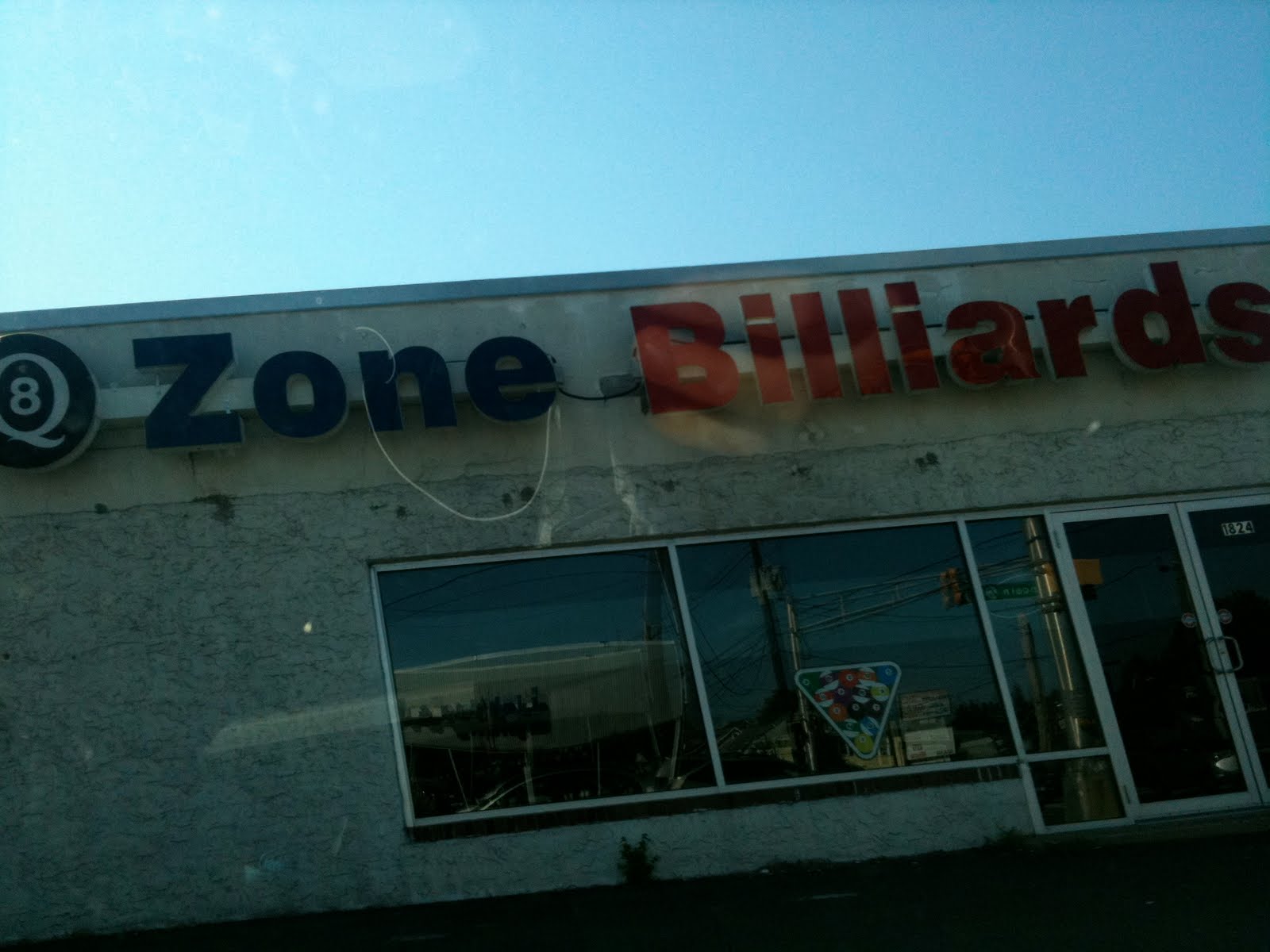
Photo: this pool hall is right around the corner from where the president will visit today in Edison. Maybe he'll pick up a game or two.

Tuesday, July 27, 2010

Holocaust Exhibit at NB Free Public Library Closing With Reception

This just in from the NB Free Public Library -- BΩS

The New Brunswick Free Public Library’s current exhibition from the United States Holocaust Memorial Museum, “Fighting the Fires of Hate: America and the Nazi Book Burnings,” will close on August 10 after a closing reception on August 5.

The exhibition’s closing reception will be held on Thursday, August 5 at 7 PM in the library’s Carl T. Valenti Community Room. The reception will feature a lecture on the organized resistance in New Jersey to the Nazi regime, presented by Ron Becker, Head of Special Collections and University Archives at Rutgers University Libraries.

Since its opening on June 14, the exhibition has attracted more than 200 visitors from the United States and Canada, in addition to the well-attended opening reception with special guests Dr. Steven Luckert, Director of the Permanent Exhibition at the United States Holocaust Memorial Museum, and Dr. Douglas Greenberg, Executive Dean of the School of Arts and Sciences at Rutgers University.

For more information about the exhibition or accompanying programs, please contact librarian Laura Szalaj at 732-745-5108, ext. 20 or via email to lszalaj@lmxac.org. The New Brunswick Free Public Library is located at 60 Livingston Avenue.

About the “Fighting the Fires of Hate” Exhibition

On May 10, 1933, upwards of 25,000 volumes of “un-German” books were burned in consciously staged book burnings across Germany, presaging an era of state censorship and control of culture. This exhibition examines the American reaction to the Nazi book burnings as well as the events’ evolution in film, literature and political discourse.

The exhibition is open to visitors on weekdays from 10 AM to 3 PM and Saturdays from 10 AM to 5 PM, or by appointment. The library is hosting this exhibition with generous support from New Brunswick’s Anshe Emeth Memorial Temple, Magyar Bank and the Kiwanis Club of New Brunswick.

About the United States Holocaust Memorial Museum

The Holocaust was the state-sponsored, systematic persecution and annihilation of European Jewry by Nazi Germany and its collaborators between 1933 and 1945. Jews were the primary victims — six million were murdered; Gypsies, the mentally and physically handicapped and Poles were also targeted for destruction or decimation for racial, ethnic, or national reasons. Millions more, including homosexuals, Jehovah’s Witnesses, Soviet prisoners of war and political dissidents, also suffered grievous oppression and death under Nazi tyranny.

A living memorial to the Holocaust, the United States Holocaust Memorial Museum inspires citizens and leaders worldwide to promote human dignity, confront hatred and prevent genocide. Federal support guarantees the Museum’s permanent place on the National Mall, and its far-reaching educational programs and global impact are made possible by the generosity of donors nationwide.

For more information about the United States Holocaust Memorial Museum, please call 202-488-0400 or visit the museum’s website at www.ushmm.org.

Monday, July 26, 2010

NB Library Receives 2010 Book Award Collection

Great news from the New Brunswick Free Public Library and the New Jersey Council for the Humanities:


The New Jersey Council for the Humanities has selected the New
Brunswick Free Public Library as one of five institutions to receive the
2010 Book Award Collection. The collection includes 33 titles nominated
by 22 publishing houses from across the county, demonstrating the
extraordinary breadth of the humanities and the insights of many gifted
authors. The collection includes this year’s Book Award Winner, The
Anti-Communist Manifesto: Four Books That Shaped the Cold War by John V. Fleming.

The books which will be presented in November cover a wide range of the
humanities including biographies of Yogi Berra, Governor Richard Hughes,
and Clark Clifford as well as histories of New Jersey during the
American Revolution. Other books range from a collection of Steinmetz
photos to Jewish architecture to New Jersey via its maps to Marc
Mappen's There's More to New Jersey than the Sopranos.

For more information, please contact E. Kim Adams, Archival Librarian,
at 732-745-5108, x20 or ekad1947@lmxac.org.

About the New Jersey Council for the Humanities

The New Jersey Council for the Humanities, a nonprofit organization, was
established in 1972 as the state partner of the National Endowment for
the Humanities. Its mission is to develop, support and promote projects
that explore and interpret the human experience, foster cross-cultural
understanding and engage people in dialogue about matters of individual
choice and public responsibility. It is funded primarily by the National
Endowment for the Humanities, with additional support from private
funders and, in some years, the State of New Jersey.

Tuesday, June 29, 2010

The City Formerly Known As New Brunswick


In my previous post, A Crucial Vote for the Hub City, about the death of Richard B. Sellars, the one-time head of the New Brunswick, NJ-based Johnson & Johnson and a pivotal voice in keeping the corporation's world headquarters in the Hub City at a time of serious urban and economic decay, I looked (albeit superficially) at the effects of J&J's presence there.

I hinted that now, at a time when builders, retailers, and institutions are once again trending toward urban environs, and transit oriented development becoming a mainstream phrase, that it might be feasible to think that New Brunswick would have been just fine -- eventually -- without the unbelievable physical and cultural sacrifices the city made to accommodate these economic drivers like J&J, Robert Wood Johnson hospital, and Rutgers University. Acres upon acres of historic commercial districts were destroyed for suburban-style "campuses," a hotel, high-end residences, etc. In the picture above, is the foundation of the so-called "Gateway," a tower that will house very high end residences that will connect with the New Brunswick train station, as well as a Barnes & Noble. The Gateway comes at the expense of one of the last 19th-century-era commercial stretches in New Brunswick.

I get it. I get ratables and attracting business and deveopment to improve the economy. On the one hand, these days it's hard to argue with developing dense mixed-use, transit-oriented development. But it all comes at the cost of city history -- one that is now barely evident.

Sunday, June 27, 2010

A Crucial Vote for the Hub City


Richard B. Sellars, the former head of Johnson & Johnson died this week at 94. His was a crucial voice in keeping the health care conglomerate in the Hub City, and arguably the reason New Brunswick, NJ is, in fact, known as the "Hub City." Just the second person outside the Johnson family to head J&J, Sellars recognized the company's commitment to its original host city, particularly when company's board of trustees was leaning toward moving the company out of New Brunswick during the city's economic nadir in the 80s; and at a time when businesses and housing were trending toward the suburbs.The New York Times, in its obituary, referenced a 1984 interview with Sellars where he recognized the importance of J&J investing in New Brunswick:
“It was apparent even then that we had a commitment to New Brunswick that we couldn’t run away from,” Mr. Sellars said in a 1984 interview. “The survival of our country depends on the survival of its cities, so we’d all better get involved in cleaning them up.”


Of course, anyone familiar with New Brunswick knows the value of Johnson & Johnson's presence, but also the significant sacrifices the city made at a time when there was little political pressure to preserve the city's historical layout and buildings, as indicated in the picture above. There, the signature IM Pei building in the background and the fallowed land in the foreground that is now home to the Hyatt New Brunswick, were once major commercial districts. The sprawl development that resulted was heralded as urban reinvestment, but it would have looked the same in suburbia. The J&J campus and the Hyatt are colossal wastes of urban land.

These days, there are several major economic drivers in New Brunswick that remain committed to the city, but there continues to be little regard to the city's historic character -- character that was, in part, established by the institutions that remain.

Tuesday, June 15, 2010

Cap 2.5 Is Propaganda, But It Should Get Towns Thinking About Consolidation -- For the Right Reasons

People who live in towns that they absolutely love are lucky. They are lucky for a number of reasons, but from a policy standpoint, they are lucky that they get to be completely sentimental, often to the point of being irrational, when it comes influencing policy. They are lucky because they have a voice and get to drive the town council nuts and have it actually produce results (unlike places like, say, New Brunswick, where driving City Hall nuts more often than not results in being stifled, harassed, shut out, etc.).

This could be wrong, but I would say that most residents of New Jersey's 566 municipalities would agree that there are several instances where it would make cultural, financial, and geographical sense for two adjacent towns to consolidate governments, police departments, fire departments, public works, and so on. I would also say that just slightly more than half of those residents would say that their town should NOT consolidate with the adjacent town. This is just my sense -- also, it's a sense based more on a pre-Great Recession and BC (Before Christie) mindset and less on new economic realities.

As governor, Jon Corzine recognized that certain towns needed to consolidate, but he never really made an aggressive case. He formed the Local Unit Alignment, Reorganization, and Consolidation Commission (yawn) that was charged to:

"Study and report on the structure and functions of county and municipal government. This effort includes the study of local taxing districts and their statutory basis. It also includes the fiscal relationship between local governments, and the appropriate allocation of service delivery responsibilities from the standpoint of efficiency"

This Byzantine mission statement is more that most of us can swallow, and resulted in kind of pushing for consolidating "the two Berlins" (not sure if that was more for symbolic purposes) and encouraged shared services between municipalities. LUARCC still exists, but while the state's Department of Community Affairs (the department that oversees LUARCC) remains in transition under the new Christie administration, it's unclear how the consolidation commission will proceed.

In the meantime, Governor Christie's tax caps, budget slashing, and overall disregard for tactful legislating will more likely than not result in towns making those tough decisions, including consolidation, that were once considered a luxury; pragmatic, but luxurious nonetheless. A quick aside: the governor's braggadocio and blind ideals do him no favors and will likely keep him from being at the helm of any real progress.

Brian Donohue from The Star-Ledger validates many of the pro-consolidation ideas documented in the late, great Alan Karcher's Multiple Municipal Madness in this NJ.com video clip. In it, you'll see some clips of Gov. Christie making some pretty good arguments in favor of municipal consolidation, using his native Mendham Township and Borough as an example of two municipalities that suffer from duplication of services, including two libraries and two school boards, not to mention two separate governments, police departments, etc.

Gov. Christie hopes Cap 2.5 will force town consolidation


When I covered the Princetons as a reporter for the local paper there, I came to understand several important things about consolidation. First, the idea that so-called doughnut towns -- both the hole and doughnut as is the case with Princeton Township (doughnut) and Princeton Borough (hole) -- share a community is kind of bogus. I mean, the Princetons share far more than other doughnut towns like Metuchen Borough and Edison Township, and Highland Park and Edison Township, and any other town swallowed by the mammoth, sprawling, Edison Township (once part of the even mammoth-er Raritan Township). But for the most part, the people living in Princeton Township and Princeton Borough are different. They do, however, share schools and a library, which, culturally speaking, is very important.

Second, as Donohue points out in his video, most arguments against consolidation are sentimental. Some very vocal groups would create specious arguments against consolidation, but those were fundamentally based on a desire to remain as two towns, just because. There are no good arguments against consolidating smaller towns like the Princetons.

Third, I will always remember something the current mayor of Princeton Borough, Mayor Mildred Trotman, said when she came into office: that consolidation would probably not be explicit, but that the towns would eventually "backdoor into consolidation." While the state does need to be more aggressive in getting towns to merge, especially towns that don't have as much in common as the Princetons do, her approach makes sense here.

Sadly, it appears that Gov. Christie's setting a 2.5 percent tax cap, while resonating well with make-believe penny-pinchers, exploits the genuine beliefs of mayors like Trotman. The tax cap is mostly propaganda, because towns have mandated expenses and contractural pay increases that exceed 2.5 percent are not addressed by the 2.5 percent cap and that those increases continue to mount, regardless who crafts the municipal budget.

Anyway, Governor Christie is speaking out against a "top-down" mandate to consolidation, but it's exactly what he's doing. That's not to say consolidation is not a fantastic, cost-cutting idea that increases efficiency and potentially improves public safety and schools, but starving towns of funds to force them to make potentially unsustainable, and life-changing decisions, is beyond reckless.